We baseball fans keep losing our heroes. Yes, athletes from all sports age, and eventually die. For me, the baseball heroes are personal, because I was Hank Aaron, and I was Roberto Clemente, and I was Stan Musial. When my brother and I played Wiffle Ball, we played with lineups comprised of those ballplayers. My brother Ed was always the Cincinnati Reds because… well just because. He is the older brother, so he got to be the Reds, our beloved hometown team.
I was the National League opposition- the Cubs, Braves, Pirates, Cardinals, Giants, Dodgers, and Phillies. Therefore, I was the one who got to be Mays, and Aaron, Musial and Clemente, Banks and Snider and those other great stars. I also got to be lesser- known players like Daryl Spencer, Junior Gilliam, and Del Crandall. I was a LOT of ballplayers!
In those innocent days, I had no idea of the struggles that some of those players faced in real life. The things that Aaron, Mays, Banks and dozens of other African-American players endured was well beyond my thinking. It was, unfortunately, very real to them.
So, as these icons pass away, I think about what they did, both on and off the field. I wish that I could have had an appreciation for their struggles, but that information was kept well out of the reach of fans in those days. They were denied stays at team hotels in some southern cities, they received terrible abuse from fans, and they certainly did not get the endorsements that white players were able to get. Of course, until 1947, African-American players were not even allowed to play Major League Baseball.
So, this is my little tribute to players lost, most recently quiet Henry Aaron, the guy who spoke more with his bat than any other way. I miss being you guys. Thanks for giving me the chance to play that role so many years ago.
So, let’s not allow ourselves to get fatigued doing good. At the right time we will harvest a good crop if we don’t give up, or quit. Right now, therefore, every time we get the chance, let us work for the benefit of all, starting with the people closest to us in the community of faith.
Galatians 6:9-10 (The Message)
There was an experiment years ago conducted with people who were in a diet study. The trait in question was the ability to move past failure and to maintain sight on the goal. In the study, participants were given highly monitored daily diets. The calorie content was regulated, and participants were to eat exactly what was put before them.
One morning, the participants were given a high calorie milkshake. I’m sure that many questioned the wisdom of drinking all of those calories first thing in the morning. It was likely the vast majority of the allowance for the whole day, however, they complied.
Here is where the study got interesting. The researchers wanted to see how the participants reacted to the experiment. They broke the group down into two cohorts, based upon this experiment. After being given the milkshakes, the participants were given more ice cream and asked to respond about their favorite flavors. They were then allowed to consume as much ice cream as they desired.
Some members, feeling that they had already “blown the diet”, went ahead and ate more ice cream, conceding that they had “already blown it anyway” Other members, believing that they needed to cut down calories as much as possible after the morning milkshake, ate only what was necessary to go along with the trial of ice cream they had been asked to do.
The point became clear about the effect of “failing once”. Some members recognized that failing once was a problem, but with determination to reach their goal, they would try to overcome the morning’s indulgence. The other members, the “hell with it” group, gave themselves permission to fail again, convincing themselves that they had already lost that day.
Further study indicated that the group who gave in to “second failures” (the “hell with it” group) did poorer in achieving the goal of weight loss. Those who were able to keep their eye on the prize, recognized their first failure, but did not allow it to get in the way of success.
We all fail. The question is, what do we do when we fail? Do we shake it off and start anew, or do we give in to shame and failure and say, “the hell with it”?
God is the God of second chances, and many more…
Prayer: Lord, thank you for never giving up on us! Amen
Disclaimer: For this blog entry, I have taken the results of several such studies and, for illustration purposes, blended them together. What I described here are the tendencies found in the mindset of how some people see failure, and how they respond.
“‘Our Father in heaven, hallowed be your name, your kingdom come, your will be done, on earth as it is in heaven…
Matthew 6:9-10
This is, of course, a passage which has given us the most well-known prayer on earth- The Lord’s Prayer. We learn it as children, and we retain it our entire lives. It is, in fact, so ingrained in us, recited in a rote manner, that we may miss the richness of the prayer.
The sentence, “your Kingdom come, your will be done, on earth as it is in heaven” sounds like a nice pleasantry that can become a bit of a catchphrase. Actually, it is the hardest thing we are called to do. We are actually being called to bring a bit of heaven down to earth by the actions we choose to do. Jesus was the embodiment of “heaven to earth”, and we are called to live that legacy out by making earth look a bit more like heaven.
Yes, we have a very long way to go on that, and no, we will never accomplish it in our tenure here. However, we have been called to not simply wait for the day we can go to heaven and all will be peace and joy. We are called to bring a measure of heaven’s peace and joy to earth. We do that by loving other people, encouraging them, helping them, grieving with them, and all other human connections that aid one another on this life’s journey.
So, the next time you recite the Lord’s Prayer, remember that he always intended for us to make earth a bit more like heaven.
Prayer: “‘Our Father in heaven, hallowed be your name, your kingdom come, your will be done, on earth as it is in heaven…
William Harvey reached London and received a warm welcome from King James. Harvey enjoyed great respect and honor from the court, and seemed to know every person of influence in London. His arrival seemed to set off a round of balls and social gatherings, which attracted lords and ladies from all around the kingdom. Harvey explained to people at these gatherings his latest adventure on the Elizabeth, as well as his exciting discoveries about the body. Harvey was convinced that the heart played a major part in the flow of blood in the body. He had done dissections of human bodies, and had seen little valves in the veins, which appeared to restrict the flow of blood to one direction. The arteries also had valves, which forced blood away from the heart.
Harvey also knew that knowledge was only part of science. Scientists also need to have patrons who support them in their endeavors financially. He was learning the fine art of money politics, as well as social and practical politics. Being in the king’s court was a fine way to advance science, he reasoned.
Edwin Carr had also come to London, invited by Lord Kensington, who had bought a thousand shares of the British East India Company. Kensington was very fond of Edwin Carr, and very protective of him as well. After all, Captain Carr would continually bring home good cargoes on the Elizabeth, giving the British East India Company vast returns on their investment. Carr was a great asset, one to be protected. Lord Kensington had just secured a bonus for Captain Carr, and he treated Carr like a son, although there was not more than ten years of age difference between them.
Edwin Carr also had the asset of dashing good looks, a fine sense of grace and humor, and a way with people. He was indeed an asset to have as a business partner.
As Carr was talking to Lord Kensington, he was regaling him about the latest voyage from Padua, Tuscany, the Greek islands, and the return trip to England. He told the story of Captain Braden’s rescue at sea, and the mutiny on the Intrepid. Kensington was fascinated with the adventure stories, but also somewhat upset about the plight of a British navy captain. After all, it was the growing power of the British navy that afforded the protection for the British East India Company’s maritime commerce. A weak or corrupt navy meant trouble for profits. That would not do!
“Captain Edwin Carr!” called an attractive woman walking briskly to offer her hand to Carr.
“Lady Kensington,” said Carr softly, “so good to see you again.”
Lady Anne Kensington was the somewhat recent bride of Lord Andrew Kensington. Prior to the marriage, she had been the Kensington’s mistress for several years. Lady Kensington was twelve years younger than her husband, and had been a friend of Carr long before she met Kensington. It was ironic that Anne Kensington now carried the title “Lady,” for when she was Anne Fox, she had acted very little like a lady. Carr remembered the stories about Anne Fox and the way that she had acted when serving his sailing friends at the Pier’s End Pub. She had met Andrew Kensington at a reception given by Jacob Carr. Jacob moved in circles that included the highest and lowest of society, where the common ground was money or the chance to acquire it. Jacob Carr had friends who were dockworkers, and friends who lent money to kings. Anne Fox had grown up in the neighborhoods of East London, near the Carrs’ home, and while not childhood friends, they were linked by the poverty of the underclass.
Lord Kensington had been attracted to Anne from the moment he met her through Jacob Carr. It was not long before Anne was seeing Kensington every week, and sharing both his bed and some of his fortune. Upon the death of Kensington’s wife, Alice, Kensington married Anne. He did this partly to satisfy his partners at the East India Company, and partly because Anne Fox would have nothing less than marriage and the title she had coveted since she was a girl.
“Captain Carr,” she continued, grabbing Carr by the arm, “I want to introduce you to some of my new friends.”
Carr was amused that she insisted on calling him “Captain Carr,” when in other settings she did not hesitate to call him Eddy, or “Bunky,” a nickname that had some rather coarse origins known only to a few of Carr’s intimates.
“You don’t want to introduce him as much as show him off!” chided Lord Kensington. “Show him off, then, he really is a prize,” he called out.
Lady Anne barely looked back at her husband, enthralled with the man at her arm. Indeed, she would show him off, and she would enjoy the evening.
As Edwin Carr and Lady Kensington whisked off to other guests, Andrew Kensington began doing some business. He circulated among the guests, discussing the current political concerns. There were a number of new faces in this gathering, and Kensington inquired of some of these new guests about their business, their family, their estates. He found that King James had opened the door very widely to peerage. There were numerous new barons, baronets, dukes, and other titled gentry, all admitted to the social elite for the price of a title. If new titles needed to be created, so be it. This was a crown with very little available money, mostly due to James’ refusal to convene Parliament. No Parliament meant no revenue from new taxes, so the resourceful king found new means of prying money from the landed wealth. He also found that these newly minted gentlemen and ladies cared little for their benefactor. Most found him to be weak, lacking in courage, and hopelessly out of touch with the people he ruled. Rumors also circulated about his fondness for young men, yet there was a strange ennui regarding the king personally. They cared little for James I, King of England, but they cared a great deal about the burgeoning economy and the potential wealth that colonies could generate. There were the very rich and the very poor. While the very poor far outnumbered the very rich, wealth had a way of keeping power away from the wretched masses in the cities.
Politics was for those who had passion for governance. Business was the passion of Lord Kensington, and he cared only for those who shared his passion, or those who could help his passion to flourish. Kensington found some kindred spirits who were interested in the tobacco trade just beginning in the colonies. More acres needed to be planted in the rich Virginia soil to increase the amount of tobacco available for export to England. Englishmen were just beginning to acquire a taste for the tobacco now being shipped to England, and Kensington was willing to bet that such a taste would mean merely the start of a valuable product. King James believed that tobacco was unhealthy, and did not promote the sale of the product. Kensington knew that there was money to be made, and that he did not necessarily need the support of a king to get rich. Yes, he would like the King’s support, but he was determined to find greater wealth no matter what.
Kensington’s attention turned to the entrance of some important guests who were just being introduced.
“The honorable Captain William Braden, accompanied by the Royal Court Physician Sir William Harvey!”
The crowd was gracious in its reception of these late-arriving guests. Many had heard the story, which had been abuzz earlier in the evening, about the rescue of Captain Braden, the mutiny on the Intrepid, and the reports of that renegade ship still at sea, possibly trying to enter Plymouth.
William Harvey was already well known in these circles as a brilliant scientist. While many failed to understand the import of his research, they knew of his prominence in the court of King James. Harvey was also well liked by those who met him, and his reputation was growing.
Kensington made his way to Captain Braden to hear firsthand of his ordeal. Braden looked frail, and every bit of his nearly sixty years of age. Kensington, at fifty-one, felt much younger in Braden’s presence, and he gave the deference to the old warrior that befitted the age difference and the respect for military service as well. As Kensington spoke to Braden, Dr. Harvey approached them with another physician friend.
“Captain Braden,” began Harvey, “my apologies for interrupting your conversation with this gentleman, but I do want you to speak with Dr. Jenner about your experience on the Intrepid. I have told Dr. Jenner that a Dr. Shepherd treated you in a most unusual way for the plague. Do you mind telling Dr. Jenner about it?”
Kensington chimed in, “By all means, Captain Braden, please tell us of your experiences on the Intrepid. I am most interested in the state of our Royal Navy and your ghastly treatment on board your own ship.”
Braden sighed, reluctant to speak once again of what felt to him like such a failure. Losing your ship, no matter what transpired, was a failure to a navy man. Nevertheless, Braden told in some detail the story of how he became ill, how Joseph Shepherd had given him moldy bread, had anointed him with oil, and prayed over him. Dr. Jenner seemed very compassionate toward the old captain, and listened out of respect. He thanked Braden for relaying the story, excused himself from the conversation, and returned to his wife, who was waiting for him near the wine porter.
William Harvey was anxious to meet Joseph Shepherd. Harvey’s greatest gift, aside from his ability to charm people with his wit and savvy manner, was his willingness to embrace new ideas. Harvey was a true scientist, desiring to advance medicine, and willing to look beyond currently accepted beliefs.
Harvey was intrigued by the idea that Braden was cured by this odd assortment of prayer, oil, and moldy bread. He was not willing to see a miraculous healing, but he was open to see medical science at work. Perhaps there was something about the bread. Maybe Shepherd had applied some other medicines, which Braden, in his delirium, had forgotten. Harvey decided that he would find Joseph Shepherd to discover more of this fantastic story. If nothing else, he would meet an interesting person. Dr. Jenner, on the other hand, dismissed the story of healing as a nice tale from a poor old man. Lord Kensington, seeing Harvey’s interest, decided that he too could be interested in pursuing this story. One never knew but that a man as well connected as William Harvey might be worth the investment of time.
Harvey glanced toward Lord Kensington and asked if he could arrange travel to Plymouth when the Intrepid arrived in port.
“I am at your command, Dr. Harvey,” answered Kensington with an exaggerated bow.
Chapter 16
William Bradford and Dr. Mullins were told that Joseph Shepherd and I were to accompany them on the rounds of the ship, and we were to be available to answer questions about the physical health of the crew. Mr. Swailes would also accompany us as acting commander of the Intrepid. Mr. North, recovering well from his shoulder injury (and more slowly from the opium treatment that we had liberally administered), was able to sit up in sickbay, but he was not clear on any recent details of the trip, and he remained below deck.
“Dr. Greene,” began James Mullins, “I expect that you will be totally honest with me about the condition of the crew. I realize that you have much to gain by withholding information about the health of the crew, but you are said to be an honorable physician and a man of integrity, so I will proceed on that assumption.”
I wanted to feign indignance at his remarks, but the fact was I probably would have shaded the truth a bit to allow entrance into port – I am not above it – but I also believed that plague was not active on the ship. For all I knew, the symptoms we had seen were not truly those of the dreaded plague. What I did know is that for weeks we had seen no sick sailors, and that we were no threat to the port of Plymouth.
“Yes,” I replied to Dr. Mullins, “I am a man of integrity, sworn to uphold my oath to medicine as well as to the crown of England. I can tell you that we have treated no sailor for signs of the plague for over three weeks. Those symptoms we did see may or may not have been the plague.”
Bradford and Mullins looked at one another and Bradford said, “If that is so, then why did you put your captain Braden adrift to die in the ocean? It is only by the grace of God that he was rescued by the Elizabeth. He lived to tell of the treatment he received from this crew.”
Shepherd and I were completely shocked at this statement, but no more than Mr. Swailes, who blanched whiter than his shirt at the pronouncement.
“Those two told us he was dying of plague!” Swailes managed to stammer out. Always the coward and now the fool, Swailes had, in his effort to save himself, shaken the credibility of the only people on board who could help get the Intrepid safely into port. Shepherd spoke through the haze of confusion, which was gathering around this conversation.
“The simple truth,” said Shepherd, “is that Captain Braden, ill, but recovering, was forced off the ship by Mr. North. You will find no more signs of sickness on this ship, at least no more physical sickness.”
Swailes was beaten, and he knew it. To refute the truth now would doom the Intrepid to more wandering outside of Plymouth. Further, his earlier outburst only served to strengthen the observation that he was a fool, a liar, and part of a rebellion that cast Braden off the ship.
William Bradford could see the truth, but he ordered that we proceed with an examination of the crew. Upon finding no signs of illness, the Intrepid would be led into port by the crew that had brought Mullins and Bradford out to the Intrepid.
Mr. Kelley, who stayed close to Shepherd and me during the visit from Bradford and Mullins, interjected a word of caution to Bradford.
“Sir,” said Kelley, “I think that you might have Swailes here and Mr. North put in irons. They was the ones who put Captain Braden out to sea.”
Swailes reached for his sword and unsheathed it quickly. He was about to slash Kelley when a pistol shot rang out from the cabin. The ball from the pistol hit Swailes in the back of his head, just at the base of his skull, and a mist of blood sprayed out around his entire head. I believe that he was dead before he hit the deck. He crumpled where he stood, and the sword flew into the air as he fell.
Bradford and Mullins were aghast at the sight of the murder. Mr. Kelley seemed undisturbed by the violence, while other crewmembers scuttled out of sight. I bent down to check on Swailes, knowing that he was dead. I never saw an exit wound, so I assumed that the projectile had coursed around his brain, killing him quickly. He was spared the hangman’s noose by the quick justice of a nervous crewman.
“He is dead,” I pronounced.
“Who fired that shot?” asked Bradford.
“Could have been a lot of men,” ventured Kelley. The casual response to death and the complacent attitude about who had killed a man shocked the visitors. I believed that it was the natural consequence of a ship that had lost discipline, and where desperate young men, exposed to battle, simply acted upon their emotions.
“Where is the captain?” asked William Bradford.
“Mr. North is below deck, recovering from an injury,” I stated.
“This is the same man that ordered Captain Braden overboard?” asked Bradford.
“Yes,” I replied. “Dr. Shepherd and I will take you to him.”
“I was not aware that there were two physicians on the Intrepid,” said Bradford.
“I am not this ship’s physician,” said Shepherd. “I am only assisting the very capable Dr. Greene.”
“I notice too that you call your captain Mr. North, so you do not afford him the same deference as you do Dr. Shepherd.”
“He is not my captain,” I said softly, letting Bradford take that how he wished. We went below deck while Kelley and two others covered Swailes with a sheet and carried him to the aft of the Intrepid.
We encountered North as he remained in a pleasant haze. He had probably heard the gunshot and the commotion, yet he had hardly stirred from his bed. Bradford introduced himself and Dr. Mullins, and he explained what they were about to do.
“Mr. North,” I began, “we believe that in a short time, after the men are examined, that we will be allowed entry into Plymouth.”
“Yes,” North said, “we should land at Plymouth.”
“We will proceed then with the examinations,” said Dr. Mullins.
“Yes, proceed,” we seemed to say in unison.
The examinations went smoothly. Mullins, Shepherd, and I gave essentially a cursory examination, consisting of visual examination, looking for the presence of buboes, performing palpation of glands under the arm and groin, and determining the presence or absence of fever. All of the men, including the two that had previously shown symptoms of the disease, heartily denied ever having felt the least bit sick in the past three months.
I noted that Mr. North had been acting a bit more suspiciously the past several hours, but I attributed that to his removal from the medications that I had been administering. However, as we came to North to discuss the plans for entry into port, he became very aroused in his anger, and he began to speak to no one in particular, saying that he would have no disloyal crew members on his ship, and that he would sail triumphantly into Plymouth with “two other men, if they are the only ones I find loyal!”
“Captain North,” said William Bradford after the examinations were complete, “we shall return to port and advise the authorities that we find no presence of illness on the ship. You will be given permission, I’m sure, to enter port in the next day or two.”
“Fine,” said North. “We shall proceed when you signal us, but I will find the crew that is loyal to me.” Then he barked to the crew around him, “Anyone who wants to leave my command had better do it now, or I swear I will hang the mutineers from the mast!”
He glared at the startled crew that was starting to gather around.
“You, Mr. James, are you loyal to me?”
David James, one of the young crewmen on his first voyage, turned red, then stammered his loyalty to his captain. Others muttered their fealty to their captain, then scrambled to posts around the ship.
Mr. Kelley then stood up and said to North, “If you want me to leave, I will.”
Kelley was quite matter of fact in his demeanor, without a trace of fear, or even anger.
“Yes, Mr. Kelley, I want you to leave,” hissed North.
At seeing this I was sure that Mr. North was completely losing his grip on reality. Surely he knew that Mr. Kelley, Shepherd, and I would tell the truth about what had happened to Captain Braden. Yet in his state of mind, he could only posture, bark orders, and intimidate those who would be intimidated.
“You all leave then. Dr. Greene, Kelley, Shepherd, and anyone else who cannot follow my command!”
“The signal for permission to enter Plymouth shall be three blue flags flown from the mast of the Mayflower,” said Bradford. With that news, Bradford and Mullins joined us in the boat to depart for Plymouth. Our voyage had come to its long-awaited conclusion.
Word would quickly spread from Plymouth to London about the Intrepid and the possible plague on board, Captain Braden’s amazing rescue by the Elizabeth, and the problem of the Intrepid’s entry into port. People were also abuzz in Plymouth about the venture made by Mullins and Bradford to the Intrepid. As our small boat approached Plymouth, it was getting close to noon. We were exhausted from our ordeal, and William Bradford offered to have us spend the next day with him and Dr. Mullins. He would afford us a warm bed, good food, and delightful companionship. These were things that I had so missed on the Intrepid for the past three months.
Bradford went to Alvin Toll immediately to apprise him of our findings. Toll realized at once that the ship was deemed to be clear of disease by our presence in port. William Bradford spoke to Toll in a cheerful tone.
“Mr. Toll,” he said, “we have found no evidence of plague aboard the Intrepid, and we believe that it is safe for her to enter Plymouth. We must also tell you, however, that we found Captain North to be quite mad, and possibly guilty of mutiny.”
Toll seemed to relish the idea of such an adventure. “I will have North arrested the moment the ship docks!” he said.
“My part in this is over, Mr. Toll,” said Bradford. “I told North that we would fly three blue flags from the Mayflower to indicate permission to enter Plymouth.”
“Thank you, Mr. Bradford,” said Toll. “I will arrange for the signal to be displayed.”
Bradford left Toll’s office, feeling that he had taken a step in leadership. His lesson from Exodus seemed to have been fulfilled in his life. He was able to lead, to have courage, to have wisdom, but all only if he submitted to God’s will and provision in his life. It was a lesson he would utilize to great advantage for the rest of his life.
Toll busied himself with preparations to receive the Intrepid. He believed that there would be a struggle with North upon entry, but that his cordon of troops would be able to handle that. Bradford and Mullins had also shared with Toll that North’s hold on the crew was tenuous, and that North’s madness was probably wreaking havoc on the crew. Toll thought it best to make sure that his arrangements were complete, so he ordered that all of the available troops were to report for duty on the dock immediately. He then ordered the flags to be flown from the Mayflower so that the Intrepid could begin her journey into Plymouth.
Within the next several hours, preparations for receiving the Intrepid were proceeding at a busy pace. Unfortunately, on board the Intrepid, things were also becoming very busy. North, becoming increasingly irrational, ordered his crew to prepare the cannons for use. His thinking was totally consumed with suspicion about everyone around him. He now believed that the Intrepid would be denied entry into Plymouth because of a bad report from Bradford.
When North trained his eyepiece toward Plymouth, he saw the three blue flags fluttering from the Mayflower, but he also saw troops scurrying into position near the dock, and he saw cannon balls being loaded into piles near the shore batteries. North was now convinced that he would need to fight his way into port. Moreover, he believed that the Intrepid was perfectly capable of taking the port in a battle. His men were battle-hardened. The soldiers in Plymouth were mostly men too unreliable for service to the King in other, more important places.
North ordered the Intrepid’s crew to prepare for battle. The men scrambled to their posts, many more dazed than excited for battle. Many wondered how they could be preparing for a fight coming into their home port. North tried to rally them, standing on the bow of the ship, sword drawn, shouting orders. North ordered the Intrepid to come about and to prepare to fire a broadside at Plymouth.
Tensions were growing in Plymouth as the Intrepid drew closer to shore. Alvin Toll raised his spyglass to see the activity on board the Intrepid. His first glimpse of the Intrepid was of Mr. North, standing on the deck, wildly waving his sword and shouting something to the crew. Toll saw that the Intrepid was slowly turning to starboard, exposing her bristling array of cannon to Plymouth. Toll screamed an order to his aide, “Prepare to fire the shore batteries at once!”
The aide hurried down the steps of the tower and ran toward the bewildered soldiers standing near the cannons looking out to sea.
“Prepare to fire!” he shouted. The men looked at one another, then several began to laugh.
“Fire at our own ship?” they laughed. “You fire the cannons if you want, we’re not.”
At that they laughed some more, but the aide cut them off, “You fire those cannons, or I will kill you where you stand!”
He brandished his gleaming sword at the sergeant in charge and swore oaths at him. Suddenly, the Intrepid’s guns cut loose and iron balls smashed into the tower, dislodging some stones, and knocking out part of the tower’s wall.
The soldiers hurried to load the cannons while another volley from the Intrepid slammed into a nearby ship, the Majesty. Splinters from the Majesty’s deck flew into the air as the soldiers hit the ground.
“Up, you cowards,” screamed Toll’s aide, “and defend this port!”
Mr. North looked pleased at the destruction he was raining on Plymouth. He could see the people on shore running for their lives. He could only imagine what they were saying and thinking as the Intrepid prepared to unleash another volley. He had not noticed Mr. Dooley approaching behind him. As he turned to ask Dooley to check on the powder supply, Dooley walked directly up to North. North looked him square in the eye and said, “Didn’t you hear me, man? I told you to check on…”
Before he finished the sentence, Dooley had plunged a dagger deep into his chest. North reeled as blood spurted onto Dooley and onto the deck. North attempted to remove the dagger, but his strength was gone before he could budge it. He fell heavily to the deck, bleeding profusely.
“The killing ends with you, North!” Dooley screamed. He turned and walked back toward the stunned sailors. “The killing is over, the killing is over,” he kept repeating.
As several crew went to check on North, they seemed to know that he was already dead. Dooley’s dagger had probably hit North in the heart, and he died quickly. Dooley kept walking around the ship screaming, “The killing is over.” The crew had indeed quit firing its cannons. The killing was over.
The soldiers on shore never did fire their cannons. As they scrambled to load and prepare to fire, Toll saw that the Intrepid was no longer in position to fire. She looked sad and beaten as she drifted toward the shore on the tide. Masts splintered, mainsail tattered, the real Intrepid was now coming into view. She was no longer a fighting ship. The Intrepid was a sad hulk drifting home after too much violence.
On board the Intrepid, several of the crew had finally taken charge and decided to raise a white flag of surrender. Toll ordered a boat full of soldiers to meet the Intrepid and bring her in. It was only after the white flag was hoisted from the Intrepid that the boat shoved off to its mission. What a bizarre scene – an English warship surrendering itself to an English port.
Mr. Dooley, still ranting, said, “I killed Swailes, I killed North, the killing is over, the killing is over.”
Do not conform to the pattern of this world, but be transformed by the renewing of your mind. Then you will be able to test and approve what God’s will is—his good, pleasing and perfect will. Romans 12:2
From time to time we all need to take a look at where we are in life and decide if it is time to reinvent ourselves. What I mean by that is that we can get complacent, gradually, with our current life situation. It is often very subtle, but we as humans are made to be curious and industrious. If we have “mastered” a part of our life, (or at least we think we do), we may be looking for “what’s next?”
I have found that every few years in my working life, I felt a need for a change of some kind. I didn’t necessarily need to change jobs, but I needed to change what I did on the job. This involves taking responsibility for ourselves. It may not be the employer’s fault that we feel “bored” or need a new challenge. We need to own that our personal growth is forcing us to make some changes.
My theory is that early in a new job, the job is “bigger than us”. We need to scramble to learn new things, and we may feel completely overwhelmed. For a while. Gradually, we learn and grow, and at some point, we feel competent and successful. Not too long after that, we may actually feel “bigger than the job”, meaning, we need new challenges to stay fresh. Then we have a decision to make- change jobs or change what I do in the job.
Of course, many times, people do not have the opportunity to maneuver much in their job description. It may be very prescribed by the employer, and there may be little room to make those changes we may desire. It is then that we can decide that we could change our attitude about the job and the people involved in the job. We can make any position better, just by our attitude about it.
We can reinvent who we are in the job. We can make the job new by our own new attitude about it. It is something that can give us satisfaction, even when the job itself didn’t change.
Prayer: Lord, give us the wisdom to be able to see your plans, and how we can make wherever we are a better place, Amen.
We are hard pressed on every side, but not crushed; perplexed, but not in despair;persecuted, but not abandoned; struck down, but not destroyed. II Corinthians 4:8-9
One of the phrases I often use with clients is “good behavior beats bad thinking”. What I mean by that is, we are often beset by thoughts which are disturbing, and that we may feel are out of control. Anxiety will do that. Thoughts can take on a life of their own, and they often depart from rationality. Anxiety, after all is typically irrational. Worry can be based in reality, but anxiety transcends rational thought and becomes “worry about worry”.
The antidote to anxiety is control. There is nothing wrong with control, it’s just that there are a lot of things we cannot control. So, I think we should try to control all the things that we can reasonably control to lower our anxiety.
One of the things that we CAN control is our behavior. We can do things which can give us a sense of comfort and security, even when our thoughts may tell us otherwise. I tell my clients to come up with their list of behaviors that they can count on when thoughts get out of control.
There are behaviors which can directly help our anxious state, such as preparation for a dreaded event (that exam, that interview, etc.), talking things over with a trusted friend for support, and making sure that we maintain our physical and spiritual health.
There are also behaviors which can just be diversions- things like watching a movie, running or walking, reading, playing a game, or a host of other activities which may just take our mind off the current spiraling thoughts.
So, good behavior can overcome bad thoughts. We do have more control than we might think about how we can respond to anxious times. Controlling the things that we can control is not a bad thing. We just need to know the difference about what is truly under our control and what is not.
Prayer: Lord, you would have us to be anxious for nothing, but our human minds struggle with that. We know that you are present in the troubled times, Amen
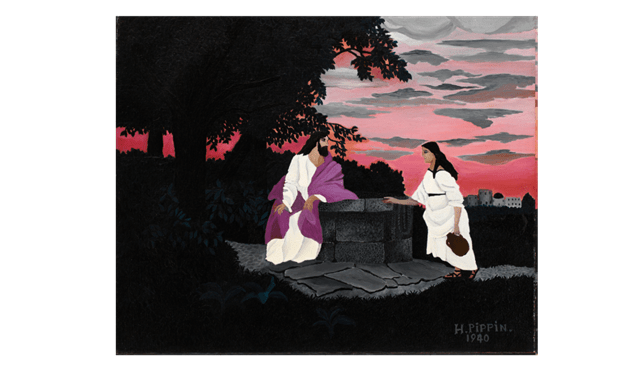
A woman, a Samaritan, came to draw water. Jesus said, “Would you give me a drink of water?” (His disciples had gone to the village to buy food for lunch.)
The Samaritan woman, taken aback, asked, “How come you, a Jew, are asking me, a Samaritan woman, for a drink?” (Jews in those days wouldn’t be caught dead talking to Samaritans.)
Jesus answered, “If you knew the generosity of God and who I am, you would be asking me for a drink, and I would give you fresh, living water.” John 4:7-10 (The Message)
I bought this painting (a reproduction), titled The Woman at the Well, when my wife and I visited the Barnes Museum in Philadelphia several years ago. This painting almost jumped off the wall at me. When I learned the history of the artist, Horace Pippin, it made sense to me why I was drawn to it. Let me tell you his story in brief.
Horace Pippin was an African-American who was a part of the “Harlem Hell Fighters” in World War I. The U.S Army was segregated in those days, so he was part of an all African-American unit which ended up spending more time in combat than any other American unit in that war.
Pippin was injured in the war, shot by a German sniper in the right shoulder. After the injury, he was only able to paint by holding one arm under the other for support as he painted. Perhaps this led to his simple, yet powerful style.
Pippin was keenly aware of racial struggles- he lived in the midst of them. Several of his paintings reflect his commentary on discrimination, and the injustice of the times he lived through.
This painting spoke to me from afar as we walked through the museum. I was struck first by the garments of both Jesus and the woman. They are very bright white, and of equal tone. The figures are also are very nearly equal in height. Both of these rendering techniques are a symbol of our equality in the eyes of Jesus.
I also noted that the woman was kind of thick around her waist, in contrast to her regularly sized face. Could she be pregnant?
Finally, there bis a red glow in the background, likely her city. This is the city to where she would return and become an evangelist of the man she had just met. Where other people saw her as a broken woman, Jesus saw her as an evangelist of good news.
I think Pippin captured something deep in this painting. He was a man familiar with inequality, and he was a man familiar with pain. To me, this comes out beautifully in his art.
I am not an art collector, nor do I know much about art. But I know when my soul is stirred by a piece of art, and this did it to me. I share it with you for your enjoyment. I think it is a great statement about the artist and his Savior.
Prayer: Thank you Father for the gift of art, and the power that can be drawn from it, Amen.
Listen, dear friends, to God’s truth, bend your ears to what I tell you. I’m chewing on the morsel of a proverb; I’ll let you in on the sweet old truths, Stories we heard from our fathers, counsel we learned at our mother’s knee. We’re not keeping this to ourselves, we’re passing it along to the next generation— God’s fame and fortune, the marvelous things he has done.
Psalm 78:1-4 (The Message)
My wife and I were going over some old family keepsakes the other day, and we unearthed some treasures. They were treasures by my reckoning. There were not any forgotten U.S. Savings Bonds, or old stock certificates, but they were treasures nonetheless. These were items of my parents, grandparents and other assorted family members. They were photos, for example, of mom when she graduated from night school. Yes, that was a thing- some kids worked during the day and attended high school at night.
I saw old documents, mom’s old coin purse, a picture of my dad smiling in a photo from my brother’s wedding. Honestly, I never remember seeing dad smile so broadly in any other picture.
I could go on and on, but here is my point. Families have rich histories. I recall watching Ken Burns’ documentary about the Civil War (incredible, by the way), and much of its heart and soul, and historical verity, is comprised of personal letters from soldiers to their wives and moms back home. We learn about the people and the times they lived in by the letters and photos they kept.
I wrote a novel, Joseph Shepherd, which is based upon the idea of a chronicle of Shepherd’s journeys with his friend, and the legacies built on that. I didn’t know it while I was writing the book, but I was writing it to myself. I was telling myself to write down, for future generations, my thoughts, feelings and beliefs.
So, I would put this consideration forth to my dear readers. Think about ways to convey to future generations what is in your history, and what is in your soul. It is well worth it, for you and for those yet unknown family members who, years from now, will unearth a treasure.
Prayer: Father, you have given us rich lives and stories to share with others. What a plan you have for us! Amen
He puts poor people on their feet again; he rekindles burned-out lives with fresh hope, Restoring dignity and respect to their lives— a place in the sun! I Samuel 2:7 (The Message)
Counseling during the COVID-19 pandemic has been a challenge. Yes, EVERYTHING during the COVID-19 pandemic has been a challenge. Every mental health problem has been exacerbated by the pandemic. Anxiety, depression, PTSD, marital problems- you name it- all have been made worse for many reasons. People feel cooped up, irritable over small things, and unable to do many of the healthy things that they might have normally done in the past.
Recently, I had the chance to suggest a bit of homework to a client. I said to her, “Imagine six months from now. It is July, 2021, and millions of people have been vaccinated against the virus. Hopefully, you too will have been vaccinated. The social shutdown is diminishing, and life has become closer to what we used to recognize as normal. What are the two things that you will make sure that you do?”
I wanted her to see that there is not only hope, but that she will have a regained sense of control- a sense that she does not currently enjoy. We need to remember that we have reasonable and realistic hopes that we can fulfill. We need to keep them before our eyes, and not lose sight of what can, and eventually will be.
So, I have my little list (actually, it might be a bit long, but that is OK!). What might your list look like?
Prayer: Father, we have hope, that blessed life-giving attribute that you have endowed us with for our good. Thank you for the excitement of such hope, Amen.
“I’ve told you these things for a purpose: that my joy might be your joy, and your joy wholly mature. This is my command: Love one another the way I loved you. This is the very best way to love. Put your life on the line for your friends. You are my friends when you do the things I command you. I’m no longer calling you servants because servants don’t understand what their master is thinking and planning. No, I’ve named you friends because I’ve let you in on everything I’ve heard from the Father Romans 15:11-15 (The Message)
I like the 12 Steps of Alcoholics Anonymous, something I am sure that I have shared with my readers in the past. The AA community has a lot of straightforward sayings that are deceptively simple- thinks like “One Day at a Time”; “Keep it Simple”; “Easy Does It”; “It Works if You Work It”; “Keep Coming Back” and dozens of other helpful phrases. A corollary of “Keep it Simple” is “It’s Simple, but it’s not Easy”.
This got me thinking the other day as I was talking with a client and reminding her that she was likely overthinking a particular situation. We all do that. It’s called “anxiety”. I talked about spiritual approaches to our broken world, and we discussed how hard the world’s problems press down on us at times, but that our calling is simple. High theology is good in its place, but when it comes to dealing with practical ways to encounter our world, it comes down to this- love God by loving one another. That is what Jesus, in his last hours on earth, told his followers to do (the passage above).
Now, that is simple, but it is not always easy. Trying to figure out a broken world, and our calling as Christians to try to be healers and reconcilers in it is hard. The solution, while simple, is not easy. Loving people in many situations is not natural, it is supernatural. By that I mean, the Holy Spirit is the one who needs to love people through us. We just need to let him.
By the way, that’s another one of the sayings for Step 3- “Made a decision to turn our will and our lives over to the care of God as we understood Him.” This is often summarized by the phrase, “I think I’ll let Him do that”
Good stuff. It works if you work it.
Prayer: Thank you Lord for your simple plans for how to heal a broken world. Help us to work toward your plans, Amen.